Sunday, October 31, 2010

New Zambrow, Poland Yizkor Book Translations Now Available for Viewing

The United Zembrover Society, the lone remaining landsmanshaft society for the town of Zambrow, Poland, has now put online within the Museum of Family History the next installment of its ongoing Yizkor Book Yiddish/Hebrew to English translation project.

Twenty new original pages have now been translated into English and are available for viewing. You can find the Museum's Zambrow Yizkor Book translation project here. The link to the new material can be found at the Project's Table of Contents page here.

Then to read the very latest translation, please click on the link "pp. 90-111."


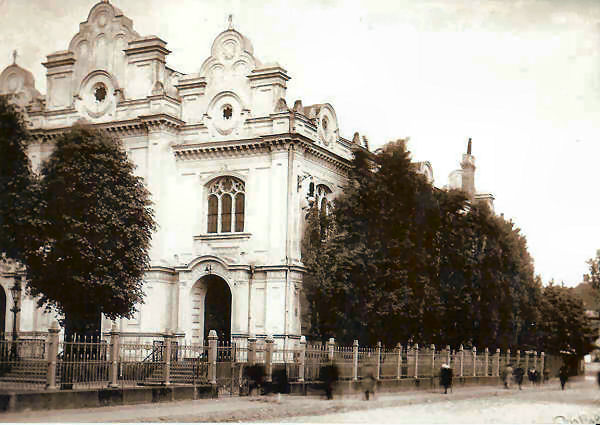
The Synagogue of Gwozdziec: A New Short Film by Tomek Wisniewski

The seventy-second film created by Bialystok native Tomek Wisniewski and made available at the cyber Museum of Family History is now available for viewing.

The name of the film is "The Synagogue of Gwozdziec" and is fifteen minutes long.

Gwozdziec was part of Poland between the two World Wars.

It was part of Galicia around the turn of the twentieth century.

After World War II, the name of the town was changed to Gvozdets and became part of the Soviet Union.

Today, the town is still called Gvozdets and is part of the Ukraine.

To see this film, please click here.

Tuesday, October 26, 2010

NY's Montefiore Cemeteries: Two New Searchable Cemetery Databases

It seems that the organization that runs Montefiore Cemetery (St. Albans/Springfield Gardens, Queens County, NY) has redone their website which now includes a searchable database. It has done the same for its sister cemetery, New Montefiore, in Pinelawn, Suffolk County, NY. Just use the links below and click on the "Locator" link at the top of the page to begin searching. You should know that the databases have only been online for about two months. They still have plenty of burials to enter and there is still some tweaking to do, so be patient. Search now for people of interest, and if you can't find them on the database, try again at periodic intervals when the databases might be updated.

The searchable fields include first name and last name, month and year of death. The search results include first name, last name, age and date of death, grave location and society name.

Here are the links:

Montefiore Cemetery: www.montefiores.com/Montefiore/jewish-cemeteries-new-york/index.html.
New Montefiore Cemetery: www.montefiores.com/newMontefiore/jewish-cemeteries-new-york/index.html.

You might be better off using the link www.montefiores.com/index.html, and simply click on the photo of either cemetery office which will take you to the particular cemetery's website.

It should be noted that the folks who run these two cemeteries are not affiliated with the group who created the other six or seven Queens, NY cemetery databases, so the form of the cemetery databases are different. These two new databases are imperfect and are no doubt missing some burials, etc., but having access to them should make for some 'happy hunting.'

So have a go at it and good luck!

Thursday, October 21, 2010

Postal Evidence of the Holocaust: The Lodz Ghetto

I'd like to encourage you to pay a thorough visit to my three new online exhibitions about World War II and the Holocaust, online at least until the end of this year.

Here are some partial descriptions of some of the postal evidence of the Holocaust that pertain to Lodz. The images that go with these descriptions will be found within each webpage of the exhibition. Just click on the Lodz link that is found within the Tours page of my "Jewish Ghetto" exhibition:

--Judenpost 20-pfennig stamp on an envelope of Rumkowski, the Litzmannstadt ghetto Jewish Elder, canceled March 11, 1944, with the Elder's date stamp, addressed to Nazi administrator Biebow. Being a local stamp, it was valid as postage only inside the ghetto. The address at Baluter Ring was the location of the office where ghetto postal workers exchanged mail with representatives of the German post office.

--An October 18, 1941, envelope from Rumkowski's office to the Association of Jews in Germany, the organization chaired by Rabbi Leo Baeck at Berlin. A May 1, 1941, money order receipt and an October 6, 1942, card acknowledging receipt of money from Prague for a ghetto resident.


--The special cancel on the envelope below reads, "By command of the Führer this city is named Ghetto Litzmannstadt." On a June 30, 1941, postal card from Chmielnik to the Jewish Elders Council of Litzmannstadt, Rose Speiser asked for information about the fate of her daughter, Gana Milter. She had written with this request several times previously, but had received no reply.

--A Łódź ghetto censor passed the January 7, 1941, registered postal card addressed to Epshiki, Russia, was censored by Germany at Berlin, and transited Moscow en route to its destination.

These can all be found within the "Jewish Ghetto" exhibition. Once there, click on the link "Ghetto Entrance" at the bottom of the page and then the Lodz link. One can find links to all three new exhibitions here.

Postal Evidence of the Holocaust: Postcards from Auschwitz

From the Museum's "Never Forget: Visions of the Nazi Camps" online exhibition and the Spungen Family Foundation's Postal Collection:

Compared to later conditions, treatment of prisoners during the first year was relatively humane. A printed announcement from the camp commandant on the back of this December 16, 1940, formular post card stated, "Each prisoner may have a packet weighing one kilogram sent to him by relatives for Christmas, but not as a packet with money order. Permitted: bread, Christmas pastries, winter sausage, tobacco products, toilet articles. Forbidden: enclosures of money, canned jelly, stamps, photographs, letters, and flammable materials such as lighters, matches, etc. For delivery the packet should have the most correct address, including the birthdate and prisoner number. The packet must be sent in the period from December 10, 1940, to January 5, 1941. All incoming packages that do not conform to camp regulations will be confiscated for the benefit of prisoners who receive no packet from home."

Below are partial descriptions of more postal artifacts from Auschwitz on display at the virtual Museum of Family History. All can be found by visiting the exhibition and clicking on the Auschwitz-Birkenau link.

--A February 28, 1942, formular envelope mailed by prisoner number 205 (first transport) to Tarnów. Boxed red censor mark on the back.

--An unmailed post card published by the Auschwitz Museum after World War II shows the camp crematorium in 1943, location of an unsuccessful prisoners' revolt in 1943.

--Enclosed inside this March 11, 1944, prisoner's formular lettersheet was a printed notice to the recipient...

--Despite the ban on Easter parcels for prisoners in 1944, one inmate received this colorful hand-painted Easter card from a relative after it had passed the camp sensor.

--November 23, 1944, insured railway express receipt for a 10-kilogram parcel of food and clothing shipped from Beatrix Wiesner at Prague to prisoner Richard Wiesner at Auschwitz.


--This October 13, 1942, telegram from the Auschwitz camp commandant to Lublin states: "Your husband died today in the Auschwitz concentration camp. Details from the commander of the security police and the SD in the Lublin district."

--On this August 2, 1943, message-and-reply postal card from Zichenau, Franz Zawacki queried the Auschwitz administration about the fate of prisoner Egon Konstanty Zawacki.

--Very few letters or cards addressed to Auschwitz prisoners have survived, for obvious reasons, so the March 27, 1943, postal card from a mother in Warsaw to her daughter at Birkenau is exceptional. The postage fee official mail parcel waybill from the printing facility of the Auschwitz central administration to the Flossenbürg concentration camp administration probably accompanied a shipment of formular stationery for prisoners.

--A March 27, 1943, air mail letter and an April 24, 1943, special delivery letter from a French forced laborer at the Auschwitz West Buchenholz labor camp operated by I.G. Farben to his parents in Meaux, France. Both were censored at Frankfurt.

--The message on this May 31, 1944, prisoner's post card from the Auschwitz-Birkenau death camp to Kolozsvar, Hungary (today Cluj, Romania)….

--This page and the two that follow document the tragedy of Arnold Singer, a German Jew of Luckau whose brother, Walter Singer, had escaped to Sweden and was trying to help Arnold leave Germany and join him.


More such postal artifacts can be found not only within this exhibition for dozens of camps, but also within the two other new exhibitions, "Persecution and Flight: the Nazi Campaign Against the Jews" and "The Jewish Ghetto." Please make a thorough visit to these three Museum exhibitions at your convenience.

An Introduction to "Never Forget: Visions of the Nazi Camps"

The Museum would like to encourage you to visit its three new online exhibitions about World War II and the Holocaust.

One of the exhibitions, "Never Forget: Visions of the Nazi Camps" is filled with photographs taken in and of the camps, Survivor stories, postal artifacts and archival film taken by the U.S. Army during Liberation.

Such film clips include the liberation of Arnstadt, Auschwitz-Birkenau, Bergen-Belsen, Breendonck, Buchenwald (and two of its subcamps Ohrdruf and Penig), Dachau, Flossenburg, Hadamar, Hannover, Mathausen (and Gunskirchen, a subcamp), and Nordhausen.

You can also see what instructions were given to camp 'inmates' and others for what was allowed to be said and sent when corresponding.

More will be posted soon on this blog, discussing the many postal artifacts that are now part of this exhibition.

Within this exhibition you should use the list of links provided to access the material on display about any of the camps mentioned, or just follow the "next" links at the bottom of each page. You can find the aforementioned exhibition here.

Friday, October 8, 2010

Tomek Wisniewski Visits Brzezany

The Museum of Family History now presents to you Tomek Wisniewski's seventieth film on display at the Museum. This ten-minute film -- or perhaps it is more accurate to call it a "photo montage with music"-- is composed of slow scans of two 1917 town photos (bird's eye view) of Brzezany/Brezehany. The film is accompanied by a classical female vocal which makes for a pleasant ten minutes.

According to Tomek, Brzezany is now in the Ukraine, but during the following year it was possessed by other countries:
From 1375 to 1772 and from 1919 to 1939, the town was part of Poland.
From 1772 to 1918, the town was part of the Austrian Empire.
From 1939 to 1941 and from 1944 to 1991 the town was part of the U.S.S.R.

You can find the link to the webpage containing this film by clicking here. Then just scroll down the alphabetical listing to Brezehany (town name spelling today) and click on the link.

Wednesday, October 6, 2010

Ben Welden on "Stage and Screen" at the Museum of Family History

The Museum of Family History is pleased to present to you the story of yet another Jewish actor, now as part of the Museum's exhibition "Stage and Screen: Jews in the Entertainment Industry." You may not know his name, but if you were a fan of the old "Superman" television series with George Reeves as I was, you will recognize him (though the photo of him included here is of a young Ben.)

Ben Welden (aka Ben Weinblatt) was born June 12, 1901 in a small house on 14th Street in Toledo Ohio. He attended Carnegie Tech (now Carnegie Mellon) to become an engineer. He also played violin. Halfway through his degree in engineering, he was talked into taking a part in a school play. He instantly fell in love with acting. After college, he acted on stage in England (their version of Broadway) and became rather famous. When he became famous, he was told to change his name. At that time, one could not use a traditional Jewish name. He changed it from Weinblatt to Welden. Ben even married royalty (an actual duchess), while living in England. After the duchess took one long look at Ben’s family in a poor section of Toledo (OH), she divorced him.

Shortly after his divorce, Ben was asked to come to Hollywood, where some of his friends were creating the American film industry. Ben instantly became a character actor – a gangster. About 235 films, 75 TV shows and 65 years later, Ben retired. He died in 1997, at age 96. Ben has his own Wiki page and a long list of movie credits that would make any actor salivate. He worked with Humphrey Bogart, Betty Davis, Lucille Ball, Jack Benny, James Stewart and many, many famous actors. He appeared on almost every episode of Superman and he was a staple on I Love Lucy, Batman, The Three Stooges, Ma & Pa Kettle and too many more to mention here.

To see photos of Ben and to read a tribute to him by his nephew Charles S. Weinblatt, please click here.

Tuesday, October 5, 2010

"Jacob's Courage," a novel by Charles S. Weinblatt

The Museum of Family History presents to you the first in a series of books that might be of interest to you. After presentation of the book cover and a synopsis, a link will be provided to the full-length version of the book, usually courtesy of the author unless the book is out of copyright.

The first book in the Museum's "Read-a-Book" Collection is Charles S. Weinblatt's fictional novel entitled "Jacob's Courage: A Holocaust Love Story." Also included within this presentation is a short video book trailer that you might like to see.

You may read below the first part of the synopsis, or click here to read the book.

How would you feel if, at age seventeen, the government removed you from school, evicted you from your home, looted your bank account and took all of your family's possessions? How would you feel if ruthless police prevented your parents from working and then deported you and your loved ones to a prison camp run by brutal taskmasters? How would you feel if you suddenly lost contact with everyone that you know and love? How would you feel if you were sent to the most frightening place in history, and then forced to perform unspeakable acts of horror in order to remain alive?

Jacob's Courage is a tender coming of age love story of two young adults living in Salzburg at the time when the Nazi war machine enters Austria. This historical novel explores the dazzling beauty of passionate love and enduring bravery in a lurid world where the innocent are brutally murdered. From desperate despair, to unforgettable moments of chaste beauty, Jacob’s Courage examines a constellation of emotions during a time of incomprehensible brutality.

Wednesday, September 15, 2010

The Holocaust in Riga, Latvia

Tomek Wisniewski, a Bialystok native, has created a short film of less than three minutes entitled "The Holocaust in Riga." The film is composed of actual film clips of Riga taken during the Occupation, including film of the burning of the Great Riga Synagogue.

You can find the link to this film among the listing of sixty Wisniewski film clips at the Museum (listed alphabetically by town) by clicking here.

I don't imagine that most of you have seen this film, so it is worth seeing through this window back to these sad and destructive times.

Tuesday, August 31, 2010

Maurice Schwartz and his Yiddish Art Theatre

For more than sixty years Yiddish acting great Maurice Schwartz has directed and performed in more than one hundred plays both domestically and abroad. His dedication to performing plays of the highest quality exemplifies the artistry that occurred within the Yiddish Theatre in the nineteenth and first half of the twentieth century. The Yiddish Theatre, in all its glory, was at its zenith on the Lower East Side of New York City, especially in the area on or about Second Avenue.

The photograph included here is of Schwartz (left) and novelist I. J. Singer, author of the novel from which Schwartz created the play "Yoshe Kalb."

For those of you whose interest lies in Yiddish theatre, you will enjoy perusing the more than twenty pages found within this exhibition. You can not only read about Maurice Schwartz the man (a link to an unpublished biography of Schwartz can be found within this exhibition), but also the actor. You can also see photographs of many of his productions and learn a bit about many of the Yiddish Art Theatre productions themselves, i.e. not only the plays his troupe performed, but also those who worked behind the scenes as well and the playwrights themselves. You will also learn a bit about Schwartz's acting troupe itself and the myriad of talented actors and actresses that once graced the Yiddish stage.

For those of you who do research about the Yiddish theatre, you will find not only a listing of most all his YAT productions, but also a page that lists in greater detil more than one hundred of his productions. This is especially interesting because of information these listings contain, e.g. full cast listing of the majority of those productions listed. You will typically find the title of the production, the playwright's name, the location and name of the theatre in which the YAT performed this production at, and the month and year the production opened. I am still missing information on many of these listings as well as complete information on other YAT productions, so if anyone has information that isn't available on this webpage, please contact me.

Though some of the material found within this exhibition has previously been presented by this online Museum, there is much new to be seen. To see this exhibition, please click here. The aforementioned page listing the more than one hundred YAT productions with casts of characters can be found at here. You can also find a listing with links to most of the Yiddish Theatre material at the Museum of Family History's Yiddish World here.

Lastly, for those of you who wish to hear and read in Yiddish (and English) some poetry written by Itzik Manger and Peretz Miransky, please visit the Museum's Yiddish Vinkl Poetry Corner here.

Sunday, August 22, 2010

New film: "Martin: The Story of Dr. Martin Kieselstein"


Dr. Martin Kieselstein is both a Romanian/Transylvanian Jew and a Holocaust Survivor, having been imprisoned in Auschwitz, Rotschweig, Alach and Dachau.

Today he lives in Israel and has become a prodigious artist, having produced many sculptures relating to the Holocaust in such mixed media as glass, bronze, clay and wood. The Museum of Family History welcomes a ten-minute film about Dr. Kieselstein and his work which can now be found within the Museum's Screening Room. This film serves as a companion piece to the Museum's online exhibition about Dr. Kieselstein which presents to you two dozen of his sculptures.

You can find the online exhibition of Dr. Kieselstein's work here.

You can find the film about Dr. Kieselstein here. This film is in Hebrew with English subtitles.

The entire list of the Screening Room's thirty-two films with links to each can be found here.

Sunday, August 15, 2010

A Jewish Community in the Carpathian Mountains: The Story of Munkacs

For those of you who are interested in Munkacs, or simply care to see how a wonderful institution has chosen to honor one of the many vanished Jewish communities of Europe, Yad Vashem has put together an interesting online exhibition about the town, both before and after the Holocaust. You can find it here.

The town has been known by names depending on the country which possessed it at the time. It has been known as Munkacs, Hungary; Mukacevo, Czechoslovakia; Mukachevo, Soviet Union; and what it is known as today, i.e. Mukacheve, Ukraine.

The Munkacs synagogue is pictured above, as it once existed circa 1930.

Tuesday, August 10, 2010

New at the Museum's Screening Room: "A Film Unfinished" About the Warsaw Ghetto

At the end of WWII, sixty minutes of raw film, having sat undisturbed in an East German archive, were discovered. Shot by the Nazis in Warsaw in May 1942, and labeled simply "Ghetto," this footage quickly became a resource for historians seeking an authentic record of the Warsaw Ghetto. However, the later discovery of a long-missing reel complicated earlier readings of the footage. A FILM UNFINISHED presents the raw footage in its entirety, carefully noting fictionalized sequences (including a staged dinner party) falsely showing "the good life" enjoyed by Jewish urbanites, and probes deep into the making of a now-infamous Nazi propaganda film. A FILM UNFINISHED is a film of enormous import, documenting some of the worst horrors of our time and exposing the efforts of its perpetrators to propel their agenda and cast it in a favorable light.

You can see the film preview here.

Saturday, August 7, 2010

Chicago's Vishnevets Landsmanshaftn Society Members List, cir 1930s

For those of you who are Vishnevets, Ukraine researchers, you might like to visit my "Landsmanshaftn in America" page on Vishnevets. Vishnevets is located in Western Ukraine (see photo). The Vishnevets webpage contains a partial listing of members of the Chicago Vishnevets landsmanshaftn society, cir 1930s. There are about thirty-five names there, though these weren't all the members of the society. There is another list somewhere that has many more, and hopefully I'll receive this second list and add it to the one currently online.

To view this list, visit the main exhibition page here and click on the "enter" link at the end of the introductory text. Then on the Table of Contents page click on the page name listed under Vishnevets. As a bonus, you will also find what presumably is their contact (home) address at the time.

Wednesday, August 4, 2010

Update on Two Upcoming Exhibitions at the Museum of Family History

The Museum of Family History is readying two new online exhibitions about the Jewish "experience" in Europe before, during and after World War II and the Holocaust.

These two exhibitions (and a third one to come later this year or early next) will, after the exhibition is finished, be partly integrated into the Museum's "World War II and the Holocaust" wing.

These two exhibitions will deal mainly with the Jewish ghettos that were formed in Europe during World War II as well as more than three dozen concentration, extermination, labor and transit camps that much of the Jewish population of Europe were incarcerated in.

The third exhibition, entitled "Persecution and Flight: The Nazi Campaign Against the Jews," will similar in nature to the other two exhibitions, though it will mostly deal with the period before the Second World War.

Within these exhibitions you will see photographs taken in Europe before, during and after the war. You will also see and hear testimony from some who survived the War. Most interestingly, perhaps for some, will be the many pieces of postal mail that will demonstrate to the Museum visitor some of the types of mail that were sent between those imprisoned (as well as from some who worked in the ghettos and camps) and the outside world. I would suspect that most who will visit these two exhibitions have never seen such examples, or at least very few at best.

There is still time for those of you who might have interesting period photographs, audio and video clips, written testimony, that might fit in well with the theme of these exhibitions. If you do have such material and wish for the Museum to add it to the exhibitions, please contact the Museum at postmaster@museumoffamilyhistory.com with the following phrase in the Subject line of your e-mail "World War II and the Holocaust Exhibitions."

The first ones to view these two new online exhibitions will be those who have signed up to receive the Museum's e-newsletter "Perspectives," which to date has only been published twice, the last time quite a while ago. This is a perk of signing up for the newsletter, i.e. you get a chance to preview selected new exhibitions before the general public.

Perhaps three or four weeks subsequent to the sending out of Perspectives, a general announcement will be made to the public of its availability. Thus if you have not already done so, you might like to sign up for Perspectives. You can do so by clicking here. Please read the entire Perspectives signup page before signing up.

Tuesday, August 3, 2010

Six more films by Tomek Wisniewski

At the Museum of Family History you can now view six new short films created from both pre-WWII and current photographs and film clips by Bialystok, Poland native Tomek Wisniewski.

The film titles include:
--Bialystok Cemetery: Painted Gravestone (Bialystok)
--The Fourth Partition of Poland: Bialystok Brest 1939 (Bialystok)
--Lodz Litzmanstadt 1939 (Lodz)
--Szczuczyn Kolno Wizna Łomża 1939 (Lomza)
--The Old Jewish Cemetery on Okopowa Street 1942 (Warsaw)
--Snapshots of Jewish Warsaw 1939-1942 (Warsaw)

You can find the links to these six films of Tomek's (along with links to fifty-one of his other films) by clicking here. The films and links on this page are listed according to the name of the town or city associated with the particular film.

Friday, July 23, 2010

Need a Cemetery Map?

The Museum of Family History's Cemetery Project contains much of interest to the Jewish genealogist. Information on more than 130,000 burials in the New York metro area, a directory of cemeteries, an exhibition of society gates, the inner workings of a typical Jewish cemetery, and dozens of photographs of cemetery maps.

These cemetery maps are not of individual society plots, but of the maps that you pick up when you visit the cemetery office, that allow you to know where your family member is buried and how to find it. Most of the maps provided are of New York and New Jersey cemeteries, but you will also find maps of Jewish cemeteries in the states of California, Florida, Pennsylvania, Massachusetts, Maryland, Illinois and Ohio, not to mention the provinces of Quebec and Mannitoba in Canada.

The latest maps to be added are from Massachusetts, i.e. from Sharon Memorial Park in Sharon, and from Los Angeles, i.e. Hillside Cemetery. It is hoped that more such maps will be added in the future, though this will mostly depend on people like yourself who can obtain such maps, scan them and e-mail them to the Museum. Please mail these maps to steve@museumoffamilyhistory.com. Ideally, they should be unmarked.
You can find the maps of the New York and New Jersey cemeteries, as well as links to maps of Jewish cemeteries in other states and Canada, by clicking here.

Three More Films from Tomek Wisniewski

Now you can see the three new Tomek Wisniewski films appearing at the Museum of Family History. There are now fifty-one of Tomek's films available for you to view, each interesting in their own right.

The first of his new films is entitled "Over the Rooftops" and is a nearly thirty-minute series of views of Bialystok, often from a "birds-eye" view. You can find the film here.

The second film is also about Bialystok, is more than thirty minutes long, and is entitled "Bialystok: Yesterday and Today, From the Heavens and the Earth." To see this film, please click here.

The third film is about the Taibl Pomerantz Jewish nursery school of Grajewo, 1926. The film is basically a seven minute scan of a student group photograph with the frequent zooming in of the faces of the young children. To see this film, please click here.

The Museum hopes you enjoy all that Tomek Wisnewski has to offer. He is quite a creative talent and cares much about the history of the Jewish people in Poland.

The entire list of and links to the fifty-one of his films at the Museum can be found here. Undoubtedly, more will follow in the coming weeks.

More Synagogue and Holocaust Memorial Photographs from Europe

The Museum has added to its evergrowing exhibitions of European synagogue and Holocaust memorial photographs.

New synagogue photos have been added for the following countries and towns:

--Austria: Kobersdorf (Kabold).
--Croatia: Varazdin.
--Germany: Dresden.
--Hungary: Esztergom, Gyongyos, Gyor, Gyula, Hajdúböszörmény, Keszthely, Kisvarda, Mad, Mako, Miskolc, Nyiregyhaza, Pecs, Siklos, Sopron, Tapolca, Tata, Tiszafured and Zalaegerszeg.
--Poland: Krakow, Tarnogrod, Tarnow and Wrzesnia.
--Romania: Targu-Mures.
--Slovakia: Samorin.
--Ukraine: Brody, Kamyanka Buzka and Vylok.

You can find these photos by visiting the particular country synagogue page. Just click here.

New Holocaust memorial photographs have been added from:

--Hungary: Budapest and Kunmadaras.
--Poland: Deblin, Kielce, Kozienice, Krakow, Lodz, Opole, Piotrkow Trybunalski, Przemysl, Radomsko, Rzeszow, Sochaczew, Tarnow, Warszawa and Wrzesnia.
--Ukraine: Rogatyn.

You can find these and all the other exhibition's collection of Holocaust memorial photos by clicking here.

More such photographs are always welcome. You may send jpegs to the Museum at steve@museumoffamilyhistory.com. Please identify the photographs, e.g. country and town where they are located, name of the synagogue, and any other information you think is relevant.

Thursday, July 22, 2010

WWI Honor Roll and Holocaust Memorial in Great Britain

New to the Museum are two pages listing Jewish soldiers and personnel who perished during both the First and Second World Wars.

In 1990 two plaques honoring those soldiers et al who died between 1914 and 1919 were transferred from the East London Synagogue to the area of the Waltham Abbey Cemetery. A photograph of the plaques and lists can be found by clicking here. Be sure to click twice on the photograph if you'd like to read what has been inscribed on these plaques.

Also in this location you can also see a memorial conceived and built by Holocaust Survivor Roman Halter, dedicated to the six million Jews who were murdered during World War II by clicking here. This is the first Holocaust memorial from Great Britain that is featured in the Museum's "World Holocaust Memorials" permanent exhibition. More are always welcome.

Friday, June 18, 2010

The Jewish New Synagogue of Harbin, China

You can now view a number of photographs of the Jewish New Synagogue of Harbin, China. It used to be the largest synagogue in Northeast China, but it hasn't be used as such since the Jews left Harbin in the 1950s. Built in 1921, it served as both a synagogue and library and has within the past number of years been renovated. Harbin used to have the largest Jewish population in the Far East.

The Harbin photos can be found at www.museumoffamilyhistory.com/ce/jasia/jasia-02c-china-harbin.htm.

Wednesday, June 16, 2010

Update on the Lodz Ghetto Cemetery Database

More names have been added to the list of those buried in the Jewish Ghetto Cemetery of Lodz, Poland, now totaling more than 3,400 burials. More will be added, but not until 2011. Not only does this list contain the names of the deceased and date and age of death, but also grave location, Hebrew name of the deceased and father and more.

The lists are displayed in two different ways, i.e. by cemetery section and alphabetically. One must also scroll across the screen the see the many columns of information available. You can also see the map of the Jewish Lodz Cemetery here and note the section number that corresponds to the individual sectional lists provided to you.

To select your preferred method of search, go to www.museumoffamilyhistory.com/ce/ghetto/lodz-ghetto-cemetery.htm and use the links provided.

Each webpage contains a photo of the cemetery, cir 1940-1944 that you might not have seen before.

This burial list is part of an upcoming online Museum exhibition entitled "The Jewish Ghetto" which will go online sometime this summer.

More Photos of the Synagogues of Europe

Many more photographs of the synagogues of Europe (now close to six hundred in all), both from sometime before World War II and of the recent past, can now be found within the Museum's exhibition. "Synagogues of Europe..." which arguably has the largest number of synagogue photos from Europe online.

More photographs will be added along the way as time permits. Recent photos added to this collection are of Polish synagogues from Przeymyl, Slupsk, Bydgoszcz, Bielsko Biala, Wlodawa, Lesko, Krakow, Szydlow, Inowroclaw, Pinczow, Kielce, Ostrow Wielkopolski, Gliwice, Wroclaw, Konskie, Lodz, Lublin, Lowicz, Piotrkow Trybunalski, Porozow and Opole.

Also from the Ukraine: Berehove, Uzhhorod, Mukacheve, Vylok; also a synagogue in Sveksna in Lithuania, Budapest and Szeged in Hungary, and Subotica in today's Serbia. You can now also see new webpages created for synagogues in Bosnia-Herzegovina, Bulgaria, Denmark, Estonia, Great Britain, the Netherlands, Finland, Norway, Sweden, Slovenia and Portugal. The main page for this exhibition can be found at www.museumoffamilyhistory.com/s/mfh-syn-europe.htm. More synagogue photos are always welcome.

An Untapped Genealogical Resource: Pre-War Gravestone Photos from Europe

One of the resources for genealogical discovery not often thought about, I don't think, are old pre-war photographs or films, e.g. where names of Jewish businesses are displayed on various signs, or where there are photographs of pre-war matzevot (gravestones) from Europe are displayed. The latter, of course, is intriguing as many of these matzevot that we can see now online no longer exist, having been destroyed at sometime from then until now.

For instance, in my latest display of Lodz Ghetto Cemetery data I have displayed at least two photos of the cemetery grounds where one can distinguish the names inscribed on at least two matzevot, one for a Sura Goldkrantz and the other for a Rivka Leah Borenstein (Borenstejn perhaps in Polish). The first photo can be found at www.museumoffamilyhistory.com/ce/ghetto/lodz-ghetto-cemetery-R-S.htm; the Borenstein gravestone photo can be found above or at
www.museumoffamilyhistory.com/ce/ghetto/lodz-ghetto-cemetery-A-D.htm. There are photos like these that are found on a number of sites, e.g. the US Holocaust Memorial Museum (http://www.ushmm.org/), not to mention others. It might be a good project--that shouldn't take that long at all--for someone to do a limited search on such sites and find such matzevot photos, and where there are names inscribed that are legible, to make a list of them, i.e. at least the name of the deceased and the town in which the cemetery is located. Then you can post them for all of us to see. Of course, you're welcome to send this list to me and I will make the list available to all online.

Of course there are many matzevot still extant within the many cemeteries of Europe, and many photos have been taken of them and put online. Many, however, are broken, missing or otherwise eroded to the point of being indistiguishable. Surely, though, there are photos online or elsewhere of matzevot that are no longer extant, that can be of genealogical value to those who are researchers of particular surnames or towns.

Just an idea for a project that sounds interesting to me. What do you think?

Sunday, June 6, 2010

Master List for Lodz Ghetto Cemetery Now Online

For those of you who are interested in learning about those who are interred within the Lodz Ghetto Cemetery, you can now view the current master list online within the Museum of Family History.

Because of the large size of the database--there are more than 3,400 burials to date--the data had to be spread over four webpages, the burial lists organized alphabetically by the first letter of the deceased's surname.

The fields include:

Plot Location (section and grave number)
Surname (English)
Surname (Hebrew letters)
Given Name (English)
Date of Death (English)
Date of Death (Hebrew)
Age at Death
Hebrew Given Name(s) (English)
Given Name(s) (Hebrew letters)
Father's Name (English)
Father's Name (Hebrew letters)
Other Surnames
Comments

You can begin your lookups by visiting www.museumoffamilyhistory.com/ce/ghetto/lodz-ghetto-cemetery-A-F.htm .

It is important to note that even though the list is divided among four webpages, it might take a minute or so (or not) to download each page. Also, because of the many fields and columns, you will no doubt have to scroll across the webpage to glean all the information for any particular burial.


There are many more burials in the Lodz Jewish Ghetto Cemetery and hopefully by sometime in 2011, more work will be done by those involved in this project to get more burial data online.

Tuesday, May 18, 2010

A question of online accessibility of Pennsylvania death certificates

Below is an excerpt of an e-mail I received today that some of you might be interested in:

"Here is the link to the website about the grassroots effort to have Pennsylvania make its older state death certificates much more accessible and also available online similar to what they have already done in other states: http://users.rcn.com/timarg/PaHR-Access.htm. We hope you will join in on this effort and if you would pass this information onto anyone you know who is into Pennsylvania genealogy and history including out-of-state residents. Every letter, phone call or email helps and you can write more than once.

This effort will only succeed with your help. Otherwise we could be stuck with the same old archaic and restricted system in Pennsylvania forever. It will not happen by itself. There are millions and millions of people who are into genealogy, but unless we speak up we are allowing those who don't care about genealogy decide what records we may or may not have access to.

By the way there are now fourteen states that have scanned images of their older state death certificates available online: Arizona, Delaware, Georgia, Kentucky, Massachusetts, Michigan, Missouri, North Carolina, Ohio, South Carolina, Texas, Vermont, Utah and West Virginia.

Six other states have extracted data available online: Washington, Alabama, Louisiana, New Mexico, Idaho and Florida. Arizona, Delaware, Vermont, Washington and West Virginia now have scanned images of their older state birth records online. The links to the various states (except Delaware and Vermont) can be found on the 'Death Certificate Databases for Other States, Etc.' section of our website."

Friday, May 14, 2010

Seven New Films for You from Tomek Wisniewski of Bialystok

There are now a total of ten short films of Tomek Wisniewski being shown at the Museum of Family History. I have announced three so far, and seven new ones are ready for you to view. Most of them have interesting instrumental music to go along with the film's scenes.

These new films include:

1. Of Bialystok, Poland:
--"Once Upon a Time in Bialystok," a very interesting film that takes you back to the Bialystok of the interwar period. Thirty minutes long.

--"The Kaufman Brothers", one of whom was Boris Kaufman, the cinematographer for "Twelve Angry Men" and others. The brothers were all natives of Bialystok.

--"A Yiddish Song in Bialystok." A large group gathers in Bialystok in 1940 to hear a couple sing what seems to be a Yiddish song. Can anyone identify the song by name? If so, please contact me privately. More films of Bialystok are to come, including a film about the Warner Brothers (also from Bialystok).

2. Of Zabludow, Poland:
--Two films of the Zabludow Synagogue, scans of photos of the interior and exterior of the synagogue, cir 1927.

3. Of Kossovo, Belarus (pre-1939, Kosow Poleski, Poland):
--"Berteza Kartuzka: The Street That is No More, 1916"

4. Of Minsk, Belarus:
--"Jewish Minsk." While watching this film, you can imagine you are walking or in a horse and buggy down the streets of Minsk as Tomek scans across a few of his very old photographs of Minsk. Also photographs of the synagogue complex and the Choral Synagogue.

You can access these films, as well as the previous films announced, on the webpage I've created listing Tomek Wisniewski's films at www.museumoffamilyhistory.com/tomek/films.htm .
Enjoy!

Sunday, May 9, 2010

Three Short Films, Courtesy of Tomek Wisniewski

The Museum of Family History now presents to you, with permission, three short films created by Tomek Wisniewski of Bialystok, Poland. He has created a great many such films, and the Museum hopes to present many of them to you in the coming months. These first three films will be shown within the Museum's Film Series until May 29th; more will be added along the way. Best to check this Museum's blog from time to time to learn when new films are available for viewing.

Here are the titles of the first three, all with an instrumental background, at least one with vocal music and Polish dialogue:

--Bialystok, Poland: Rabbi Gedaliah Rozenman (once the Chief Rabbi of Bialystok);
--Tykocin, Poland: The Tykocin (Tiktin) Synagogue, 1929;
--Suwalki, Poland: Suwalki 1937 (That Which is No More.)

The links to these web pages/films can be found by clicking here. The links are at the top of the film listings.

Additionally, if you would like to learn more about the history of the Great Synagogue in Bialystok, read the memoirs of Rose Schachner, a granddaughter of the builder of the synagogue, Solomon Rabinovitch. You can find her short biography by clicking here.

Saturday, May 8, 2010

The Landsmanshaftn Collections at the Center for Jewish History, New York City

For those of you with more than a passing interest in a particular landsmanshaftn (mutual aid societies established by many of our ancestors to assist their fellow Jews from the same hometown who came to live in such countries as the U.S.), you should consider visiting the Lillian Goldman Reading Room, found within the Center for Jewish History (CJH), which is located within the YIVO building in New York City. Whether it be AJHS's collection entitled "Landsmanshaftn and other town and country-related organizations incorporated in New York County, 1848-1920" which can be found at http://www.jgsny.org/landsmanshaft/ajhs.htm), or YIVO's catalogued landsmanshaftn collection (found at http://www.jgsny.org/landsmanshaft/yivo.htm), you might be surprised by some of the material you may find.

First, search the tables on these pages (there are also some other worthwhile collections to peruse at http://www.jgsny.org/ to see if the European town you're interested in, or the landsmanshaft itself, is listed. If so, and if it is possible for you to go there yourself, visit the Reading Room between most any Monday through Thursday and the friendly and helpful staff will help you find what you need.

When I visited the Reading Room a few weeks ago in search of historical information about the society to which I belong to, i.e. the United Zembrover Society, I was pleased to find plenty of interesting material, and you might too for your own town or society of interest. Of course, there might also be very little there for you even if a folder for your society exists, but you never know until you check.

The AJHS (The American Jewish Historical Society) has many incorporation papers on microfilm, and you are permitted to copy by yourself any of the pages of interest you find for a quarter per page.

As to incorporation papers, you will probably find the date the society was incorporated, the names of the officers and their official positions (and even their home addresses); the "purpose" of their society being formed, and more.

On YIVO's landsmanshaftn papers, you may find hard copies of many papers, ledgers, photographs, names and addresses of members, and even souvenir journals. Sometimes, of course, papers or journals may be solely or mostly in Yiddish, but not always. What also is of interest are the maps they sometimes have of the society's burial plots. They may also have copies of contracts made between a society and a cemetery for a purchased plot that the society wished to use to bury their members when the time came. The helpful staff that works within the Reading Room will charge you thirty-five cents per page to copy the materials they hold, but they will do the copying for you.

So why not check out at least the two aforementioned webpages when you can? By doing so, and then perusing either the microfilm or society's papers, you may learn when a society was formed, who the officers were, maybe when a particular cemetery plot was purchased (on how much space for how much money), or when the society gate was erected, etc. You may also find other interesting items within these collections, but you'll have to check what each folder or microfilm contains.

If you don't live in the NYC area but discover that records are available for your society, you may want to contact the Center for Jewish History by e-mail or phone and ask them what you're options are for getting copies of these materials. The URL for the Lillian Goldman Reading Room is http://www.cjh.org/collections/readingroom.php.

Best of luck!

Monday, May 3, 2010

New "Walk in My Shoes: Collected Memories of the Holocaust" Entry for Kaunas, Lithuania

Ed (Ephraim) Gruzin was born in 1927 in Kaunas (Kovno), and is a survivor of the Kovno Ghetto and Kaufering concentration camp number one near Landsberg, Germany. He has written a biography of his life and has graciously given permission to the Museum to make his story available to all museum "visitors."

You can read his story, as well as see some of his family pictures, by clicking here.

This is the Museum's first WIMS entry for Lithuania. More such stories are welcome, no matter from what country the Survivor comes from.

Sunday, May 2, 2010

Time Travelling to Coney Island, 1905 to 1952

Now that summer is fast approaching here in the U.S. (it begins at the end of June), thoughts of past years of frolic at the beach come to mind. So to get a head start on summer and the inevitable thoughts of Brooklyn's Coney Island come to mind (especially among those who once visited there), I have put once again online the five videos about Coney Island that once graced the Museum of Family History's Film Series. You can now watch them at your leisure.

These short films include:

--A group of young women from a boarding school spending the day at Coney Island in 1905.

--A film of Fatty Arbuckle at Coney Island, 1917, which includes visions of Luna Park.

--Coney Island of the 1940s.

--Coney Island Freaks, B-Girls, and a Touch of Tatooing.

--Coney Island in 1952.

So you can now spend nearly an hour getting a whiff of sea air and yesteryear watching these five short films which cover a span of nearly fifty years of the once great Coney Island. Now it is a mere shell of what it was with perhaps large buildings filled with condominiums and a shopping mall in its future, but we can still keep alive the memory of Coney Island in our own minds as long as we can travel back in time through the magic of film. Enjoy--and don't forget the sunscreen!

The videos can be found by clicking here.

The rest of the Coney Island exhibition begins here and consists of the introductory page and a short history of early Coney Island. You can find the first page here.

Publication of “Skala on the River Zbrucz,” a translation of the Skala Yizkor Book

In 1978, the Skala Benevolent Society (SBS) published a Yizkor [memorial] book called Skala. The book was written by the town’s (shtetl’s) former Jewish residents who either had survived the Holocaust or had been born in Skala and previously had emigrated. Its purpose was to honor Skala’s Jewish community, which had been annihilated by the Nazis and their cohorts. Most of the contributors to the original book were the survivors themselves, who felt a deep inner compulsion and moral obligation to those who perished, to tell the story of Jewish Skala and to share with their children and future generations their memories of suffering, struggle and loss. The Yizkor book was written primarily in Yiddish and Hebrew and was largely inaccessible to many modern researchers, most of whose families came from this shtetl. Skala on the River Zbrucz, a translation of the entire Yizkor book into English, now has been published by the Skala Research Group (whose members are investigating their roots in Skala) and the SBS.

Situated in eastern Galicia and once ruled by Austro-Hungary, the town of Skala was part of Poland during World War II. It now is called Skala Podil’ska and is part of Ukraine. The Skala Yizkor book includes articles, photographs, and documents on the history of the town’s Jews from the 15th century up to and including the Holocaust, when the Jewish community was completely destroyed. This material recalls a once vibrant shtetl, its people, the environment in which they lived, their hopes, dreams and struggles for survival. The Yizkor book also describes the tragic events of the Holocaust, stories of those who survived and provides a list of Skala’s Holocaust victims and survivors. The English translation contains a new chapter about the town’s righteous gentiles who saved Jews during the Holocaust, as well as photographs showing Skala as it is today. It is a precious legacy that deserves to be preserved.

For copies, please contact Tony Hausner, thausner@gmail.com .

The book will be distributed to contributors at a luncheon to be held on May 16, at 12 p.m. at the Darna Restaurant , 600 Columbus Avenue (89th St.), New York, NY 10025.

Thursday, April 29, 2010

Immigration at the Museum of Family History: A Review of Two Current Exhibitions

For those of you who haven't yet visited the Museum's exhibition titled "A Multitude of Immigrants," may I suggest you do so at your convenience.

The online exhibition contains eleven articles written between 1891 and 1910, and published in such New York City newspapers as the Daily Tribune, the World and the Sun. The articles are interesting in many ways, particularly if you're curious as to how these newspapers portrayed the "flood" of immigrants that passed through New York City ports around the turn of the twentieth century, as well as how they tried to regulate the inflow.

As a sort of "companion" piece to this exhibition, please visit "Castle Garden and Ellis Island: Ports of Immigration." Here you may read any or all of the dozen newspaper articles that talk about the history of Castle Garden and Ellis Island, all written and published between 1887 and 1909.

When read as a whole these articles give us a chance to "taste" the sentiment of the time toward immigration and the Jewish immigrant specifically.

You can find the exhibition "A Multitude of Immigrants" by clicking here.

You can find the exhibition "Castle Garden and Ellis Island" by clicking here.

Tuesday, April 27, 2010

A Review of the Searchable Cemetery Databases in the Metro New York Area

Now that I've announced the presence of a database for burials at New York's Knollwood Park Cemetery, I thought that this would be a good time to review the number (ten) of searchable, online burial databases that are currently available for Jewish cemeteries in the metro New York area (including New Jersey).

There are ten such databases online at present, though there are actually only eight, as the cemetery database for Mt. Carmel includes the burial data for both the nearby Hungarian Union Fields Cemetery and Knollwood Park Cemetery. Below, along with name and town location of each cemetery, I've also included the approximate number of burials in each. The sum total of burials included within all these databases mentioned below are more than 810,000. I know of no other cemetery in the New York metro area that is currently creating their own searchable cemetery database.

New York:

Mt. Hebron Cemetery, Flushing, Queens, http://www.mounthebroncemetery.com/, 217,000 burials.
Mt. Zion Cemetery, Maspeth, Queens, http://www.mountzioncemetery.com/, 210,000 burials.
Mt. Lebanon Cemetery, Glendale, Queens, http://www.mountlebanoncemetery.com/, 88,000 burials.
Mt. Carmel Cemetery, Glendale, Queens, http://www.mountcarmelcemetery.com/, 69,000 burials.
Mt. Judah Cemetery, Ridgewood, Queens, http://www.mountjudah.com/, 54,000 burials.
Mt. Ararat Cemetery, Lindenhurst, Suffolk, http://www.mountararatcemetery.com/, 45,000 burials.
Knollwood Park Cemetery, Ridgewood, Queens, http://www.mountcarmelcemetery.com/, 17,000 burials.

New Jersey:

Riverside Cemetery, Saddle Brook, http://www.riversidecemetery.org/, 65,000 burials.
Mt. Moriah Cemetery, Fairview, http://www.mountmoriahcemeteryofnewjersey.org/, 29,000 burials.

Knollwood Park Cemetery Burial Data Now Online

I noticed today that Mt. Carmel Cemetery (Glendale, Queens, New York), which has taken over supervision of the nearby cemetery Knollwood Park Cemetery(in Ridgewood), has finally put online the information about the Knollwood Park burials.

There are currently over 17,000 burials listed now and I am assuming that this is the current number of burials at the cemetery. You should be forewarned, however, that most of the dates of death, especially the deaths pre-2000, are not included. These dates are simply listed as 1/1/1900, which is the default date for the database. I have no idea why this happened or if it will be fixed in the future.

The Knollwood Park burials are listed as Cemetery Section 5 within Mt. Carmel's website. Sections 1 and 2 are of the main "old" Carmel Cemetery; Section 3 is of the New Carmel Cemetery (down the road), and Section 4 is of the (former) Hungarian Union Fields Cemetery. You can find the burial data for these five sections combined as one on the Mt. Carmel Cemetery site at www.mountcarmelcemetery.com . I imagine if you find a burial for Knollwood Park and would like to know the actual date of death for someone, you can telephone either Knollwood Park or Mt. Carmel; I'm not sure if one or the other or both have that information.

Monday, April 26, 2010

Would You Like to Display Your Pre-War Family Photos from Europe in a Museum?

The Museum of Family History proudly displays more than a thousand pre-war family photos from Europe. Hundreds of followers of the Museum have e-mailed the Museum scans of their precious family photos, wishing to not only share images of their family members and ancestors with all of us, but to simply honor their memory. Once in a while someone even sees a connection between their family tree and the family tree of the person who posted their family photos and both parties are put in contact with each other.

Also, placing one's family photos within the Museum's "Postcards from Home" permanent exhibition allows one to share their photos with other family members living in different parts of the world, saving them the dilemma of how to send a cousin, for example, a family photo without having to make copies, etc.

So your family photos are always welcome. Within the "Postcards from Home" exhibition, the photos are organized not only by country and town name, but also by family surname, so someone with a particular interest in a country or town or surname can make a specific search.

How does one submit photos for inclusion within the Museum's website?

First, of course, you must scan each photo and document into a folder within your computer, preferably scanning them as jpegs. The Museum prefers that you not send it originals for obvious reasons. If you haven't a scanner, there are many drugstores that have them, and you may scan your photos there by their photo department onto a CD and you can subsequently mail the CD to the Museum.

Then, after you've scanned the photos into a designated folder, you can send them to the Museum in groups of ten or twelve or more depending on the size, at postmaster@museumoffamilyhistory.com . You might want to send a second email at the time to the same e-mail address, letting the Museum know that the photos are on their way. In the subject heading of the e-mail that contains the photos, you may wish to type, for example, "Sam's family photos." I will let you know when I receive them.

If you can identify any/all of the people in each photo, please do. Assign a country and town name to each photo, so at least for the Museum's Postcards from Home exhibition, they can be placed correctly within the exhibition.

If you know the date the photo was taken, or can approximate it, please do. Surely you will not know the name of each person, and you may not have a clue as to the date, but do what you can. Perhaps you can label the photos to reflect their name, or family name. Preferably no spaces should be left between words witin the file name (if possible).

If a particular photo is from a photographic studio, e.g. it has the name of the studio/photographer imprinted at the bottom of the front of the photo mount, don't crop it; simply send the complete front photo, etc. If there is a lithographic design on the back of the photo that tells us the name of the studio, its address, etc., please send that too. There is also no need to touch up the photo as the Museum does that to its satisfaction.

If the photos are simply of life in a town and you don't know the names of the people in the photo, that's fine. Best to e-mail all the photos to the Museum and let me decide what I can and cannot use.

That should do it. If you have any questions, please write to me at steve@museumoffamilyhistory.com and ask.

You can visit the Museum's "Postcards from Home" exhibition at www.museumoffamilyhistory.com/pfh-a.htm .

Tuesday, April 20, 2010

The Museum's "Great Cantors" exhibition

The Museum of Family History now has filled its "Great Cantors" room with short bios, photos, sound and video clips of eight well-known cantors, i.e. Cantors Yossele Rosenblatt, Mordechai Hershman, Gershon Sirota, Moshe Koussevitzky, Zavel Kwartin, David Roitman, as well as Richard Tucker (pictured left in 1933, the famed tenor who was also a chazzan) and Moishe Oysher (a chazzan as well as star of a number of Yiddish films.)

You can visit the "Great Cantors" room at www.museumoffamilyhistory.com/cantors.htm .
Webpages about other well-known cantors will be added to the room in the near future.

Monday, April 19, 2010

Cantor Rosenblatt sings in "The Jazz Singer"

Cantor Yossele Rosenblatt appeared as himself in the 1927 talkie "The Jazz Singer" starring Al Jolson. As the first entry into the Museum's "Great Cantors" room (which may be found by visiting the Museum's plan for its Second Floor), a webpage has been created so you may enjoy a film clip of this performance.

You will see Al Jolson as the character Jakie Robin, attending the Rosenblatt concert while conflicted between his desire to become an entertainer and the wish of his father, a Cantor, who would like Jakie to follow in his footsteps. In this YouTube video, Cantor Rosenblatt sings a secular Yiddish song.

One can find the aforementioned page by clicking here.

Sunday, April 18, 2010

Cemetery Project Q & A: Markers at Baby's Gravesites

Recently, someone wrote to me with a question about baby markers, and how to keep the gravestone from completely sinking into the ground over time.

The question was:
"I recently had a baby marker created but the monument dealer/installer never heard of adding cement around the bottom of the stone and doesn't see how it prevents the stone from sinking. My question to you is: Do you know where I can obtain proof to show to the dealer?"

I then wrote to Todd Ivler, the cemetery manager from Mt. Judah Cemetery in Ridgewood, Queens, New York, whom I've interviewed in the past.I know Mt. Judah has handled a good number of such burials, so he was the one to ask.

I thought his response might be of interest to some of you, as many any of us who have visited our Jewish cemeteries have noticed that these small markers often appear eroded, oriented on a slant, or are partially or completely sunken into the ground.

I don't doubt that decades ago baby markers were sometimes made of sandstone and probably not set in cement, etc., but Todd's response at least can be said to reflect the method commonly used today, at least at his cemetery. Here is his answer:

"We call a baby marker a piece of granite that is twelve inches from left to right, usually at least three feet high and about two inches thick. When placed in the ground we pour concrete in the hole first then on the sides which leaves about a inch or two around the whole stone. This helps the marker from not sinking."

You can well imagine how difficult it is to find a baby's burial site for the reasons I've mentioned above. It's one thing for a cemetery to have a searchable burial database; at least one can look up a name, even if the gravestone marker is nowhere to be found or is highly illegible. Without such a source of data, one can always of course, try contacting the cemetery office, though there is often less burial information about a baby than an adult.

You can read the complete interview the Museum had with Todd Ivler, Mt. Judah Cemetery manager at www.museumoffamilyhistory.com/qna-cem-mgr.htm .

Saturday, April 17, 2010

The Museum's Film Series: Two Short Films of the Nazi Death Camps

From Saturday, April 17 through Sunday, May 9 you can view two short films about the Nazi death camps. One is part of a documentary once presented on British television, the other a Universal newsreel.

Nazi Death Camps (5 mins, 03 secs):

In April 1945, U.S. and British troops entered the Nazi death camps and filmed the horrors they found there. For decades the film was stored at the Imperial War Museum in London. This documentary was unfinished and was missing soundtracks. The directors, including Alfred Hitchcock, had developed a script to go with the pictures. Frontline, a British television program, presented this documentary unedited. It was a film the British Government deemed too grisly for release after World War II. The film has received its public debut on British television. Fifteen minutes of the black-and- white film, which was shot by the armed forces after the war. From YouTube. You can see the short film by clicking here.

Nazi Murder Mills (8 mins, 16 secs):

First actual newsreel pictures of atrocities in Nazi murder camps. Helpless prisoners tortured to death by a bestial enemy...Here Is "The Truth" (Real-life horror pictures revealing the unbelievable atrocities committed by the Nazis in their murder camps.)

Grasleben: Wounded and emaciated Yanks, captured in von Runstedt's Bulge attack of last winter, are fed and given medical care by the Yank armies of liberation.

Hadamar: Protected by gas masks, grave diggers open reeking graves at this converted insane asylum. They discover that 35,000 political prisoners had been slain here, largely by poisoning.

Camp Ohrdruf : General Eisenhower, General Patton and General Bradley can hardly believe their eyes when they view torture-gallows, heaps of charred human bodies and lime pits filled with corpses. From You Tube.

You can view the newsreel by clicking here.

Sunday, April 11, 2010

The Complete Memoir of Peter Kleinmann of Munkacs

There has been a good addition to the Museum's ongoing and evolving exhibition "Walk in my Shoes: Collected Memories of the Holocaust."

You can now read the complete memoirs of Holocaust survivor Peter (Dezider) Kleinmann, who was born in 1925 in the small village of Kustanovice, about a one hour walk from the city of Mukacevo (aka Munkacs, Hungary; Mukacevo, Czechoslovakia; Mukachevo, Soviet Union; today Mukacheve, Ukraine).

Peter writes about:

Jewish communal life in Munkacs
The rise of anti-Semitism during Hungarian occupation
The Munkacs ghetto
Deportation
Existence in the concentration camps Auschwitz, Gross-Rosen and Flossenburg
The Death March
Liberation

There are a good number of photos included, both of family, scenes around towns, a sanitorium in Switzerland, and also of the camps.

You can begin to read his memoirs at www.museumoffamilyhistory.com/wims-kleinmann-01.htm.

More about Peter Kleinmann, including video testimony, will be made available to you sometime this year once the Museum's "World War II and the Holocaust" section has been augmented and made ready for viewing.

The submission of more such memoirs to the virtual Museum of Family History are also welcome and will be considered for inclusion within the Museum's "Walk in My Shoes" online exhibition.

Monday, April 5, 2010

MOFH Film Series: Now Playing until April 18th

Now showing within the Museum of Family History's Film Series, through April 18th:

Film no. 1:

Archival film from 1936 showing the Jewish district of Kazimierz in Krakow (3 mins, 26 secs). Most of these buildings can be visited today and are in a similar condition - only the people who walked those streets are long since gone.

The original [version] of this film is in the Polish film archives in ul. Chelmska in Warsaw. -- From YouTube.

Note that there is another version of this film on YouTube that states the film is of Kazimierz in 1938-9, not 1936.

This short film "The Jews of Krakow's Kazimierz District," can be found at www.museumoffamilyhistory.com/fs-krakow-kazimierz.htm .

Film no. 2:

From the exhibition "The Jewish Ghetto," coming to you at the Museum of Family History sometime in 2010:

"The Ghettos of Dąbrowa Górnicza and Będzin" (10 mins, 51 secs):

A film in two parts, shot in the ghettos of Dąbrowa Górnicza and Będzin, probably at the beginning of the ghettos.

Dabrowa Górnicza is part of the Katowice conurbation. Jews settled in Dąbrowa Górnicza in the middle of the 19th century. There were 4,304 Jews living in Dąbrowa Górnicza according to the 1921 census (11% of the total population).

The German army captured Dąbrowa Górnicza on 3 September 1939. In the fall of 1940 several hundred young Jewish men were deported to slave labor camps in Germany. Several hundred more were deported in the course of 1941. At the end of that year a ghetto was established. On 5 May 1942, the first deportation took place in which 630 Jews were taken to Auschwitz and exterminated. In the second deportation, conducted on 12 August 1942, another few hundred Jews were sent to their death in Auschwitz. On 26 June 1943, the ghetto in Dąbrowa Górnicza was liquidated and all its inmates were transferred to the ghetto in Srodula (a suburb of Sosnowiec), the only ghetto still existing in Upper Silesia. It too was liquidated and all its inhabitants, including the Jews from Dąbrowa Górnicza, deported to Auschwitz and killed.

According to the 1921 census, there were 17,298 Jews in Będzin or 62.1 percent of its total population. By 1938, the number of Jews had increased to about 22,500.

Situated close to the border, Będzin was quickly captured by the Wehrmacht. On 7 September, persecution of the Jews began, with the instituting of economic sanctions. On 8 September, the Będzin synagogue was burned, and the first massacre of local Jews took place.

The ghetto was founded in May 1942 but deportations had started as early as October 1940. Despite cooperation with the occupiers as is shown in this film, several large deportations took place in 1942. The last major deportations took place in 1943: 5,000 were deported on 22 June 1943 and 8,000 around 13 August 1943. About 1,000 remaining Jews were deported in the subsequent months. A rising took place in August 1943 which was put down and the ghetto was eliminated.

This film is held in the Polish film archive in ul. Chelmska, Warsaw. -- From YouTube.

The film can be found at www.museumoffamilyhistory.com/fs-ghettos-dabrowa-gornicza-bedzin.htm .

Film no. 3:

Jolson sings in "Hallelujah, I'm a Bum!"

The film trailer.
"The picture, some persons may be glad to hear, has no 'Mammy' song. It is Mr. Jolson's best film and well it might be, for that clever director, Lewis Milestone, guided its destiny, and the supporting cast includes Frank Morgan, the beautiful Madge Evans, the pathetically comic Harry Langdon and that veteran of Keystone days, Chester Conklin. It is a combination of fun, melody and romance, with a dash of satire, all of which make for an ingratiating entertainment..."-- From the New York Times, Feb. 9, 1933.

Don't forget to visit the Museum's large Al Jolson exhibition titled "The Immortal Al Jolson" (and see and hear many more videos, not to mention more than forty sound clips) at www.museumoffamilyhistory.com/ajolson.htm .

Friday, March 26, 2010

ERC Lecture Series: The Development of Yiddish Literature Since the Czernowitz Conference

From Iosif Vaisman, in his description of the first Yiddish language conference:

The First Conference for the Yiddish Language, also known as the Tshernovits Conference, opened on Sunday, August 30, 1908. The Conference was convened to discuss very important topics, formulated in the ten point Conference agenda. To what extent the Conference succeeded in finding the solutions to any of these ten problems has been a subject of discussions (sometimes quite fierce) ever since. A simple look at the agenda is sufficient to see that many issues have yet to be resolved:

1. Yiddish spelling
2. Yiddish grammar
3. Foreign words and new words
4. A Yiddish dictionary
5. Jewish youth and the Yiddish language
6. The Yiddish press
7. The Yiddish theater and Yiddish actors
8. The economic status of Yiddish writers
9. The economic status of Yiddish actors
10. Recognition for the Yiddish language


In October 2008 Boris Sandler, Editor-in-Chief of the Forverts newspaper, gave a speech in Yiddish to attendees of the IAYC (International Association of Yiddish Clubs) conference about the development of Yiddish literature since this 1908 conference.

A transcript of his talk on this subject is available now in English and can be found within the "ERC Lecture Series" at the Museum's Education and Research Center.

You can read a transcript of his talk at www.museumoffamilyhistory.com/iayc2008-sandler.htm .

Wednesday, March 24, 2010

Wily Marriage Makers of the East Side, 1905

The schatchens, i.e. the matchmakers, of the lower East Side in a 1905 article in the Los Angeles articles were described as both good and bad.

The schatchen is almost invariably of one type. He is not very tall; he is bearded, patriarchial and intensely Yiddish. he walks silently and watches every chance passerby with eyes that are both furtive and keen. He slips in and out of places almost without making his presence felt. When he speaks it is with a marked desire to please, but with strangers he is cautious and slow of tongue...


The article further states that the schatchen--

is a busy, prosperous man, with a good business and a large following of clients, and he has developed his ancient and picturesque trade along the modern lines of commercial America, but withal he remains the schatchen--the matchmaker, the trafficker in young men and maidens, the indefatigable, serene, obsequious, popular marriage broker.

However, the article's author states, there are also crooked, swindling schatchens, who are "next to impossible to arrest or convict."

So then if you are interested in learning about the good schatchen and the bad schatchen, please read this article. The article can be found at www.museumoffamilyhistory.com/les-marriage-makers.htm .

"Glimpses of Yiddish Czernowitz": A Forverts Film

A new film comes to you from the Forverts, i.e. the Yiddish Forward newspaper. The film is in Yiddish but has English subtitles. You can see the film's trailer at www.museumoffamilyhistory.com/sr-30-yiddish-czernowitz.htm .

Here is a description of the film:

Bukovina—land of the beech tree spreading its branches across the Carpathian Mountains with its turbulent rivers and rushing streams. More than one generation of forest merchants and cattle drivers in partnership with the local peasantry drew their livelihood from the land. Czernowitz was blessed with resonant names—the Big City, Little Vienna, Jerusalem on the Prut, Jerusalem of Bukovina.

Short, but abundant visually, this filmic essay expresses critical historical moments of Jewish life in the city and region, from the first Jewish language conference to the torment of the Transnistrian deportation and subsequent decline of Jewish life in the post War period. Featuring contemporary interviews alongside original archival images, the film presents Czernowitz through native personalities such as fabulist and pedagogue Eliezer Steinbarg, beloved actress Sidi Tal, drama critic Moyshe Loyev, writer Josef Burg, poet Beyle Schaechter-Gottesman, and linguist Prof. Wolf Moskovich.

Glimpses of Yiddish Czernowitz is a visual tale of an all but lost Jewish community. The film awakens our longing and calls us back to seek out the traces of that city of our dreams—the Jerusalem on the Prut.